
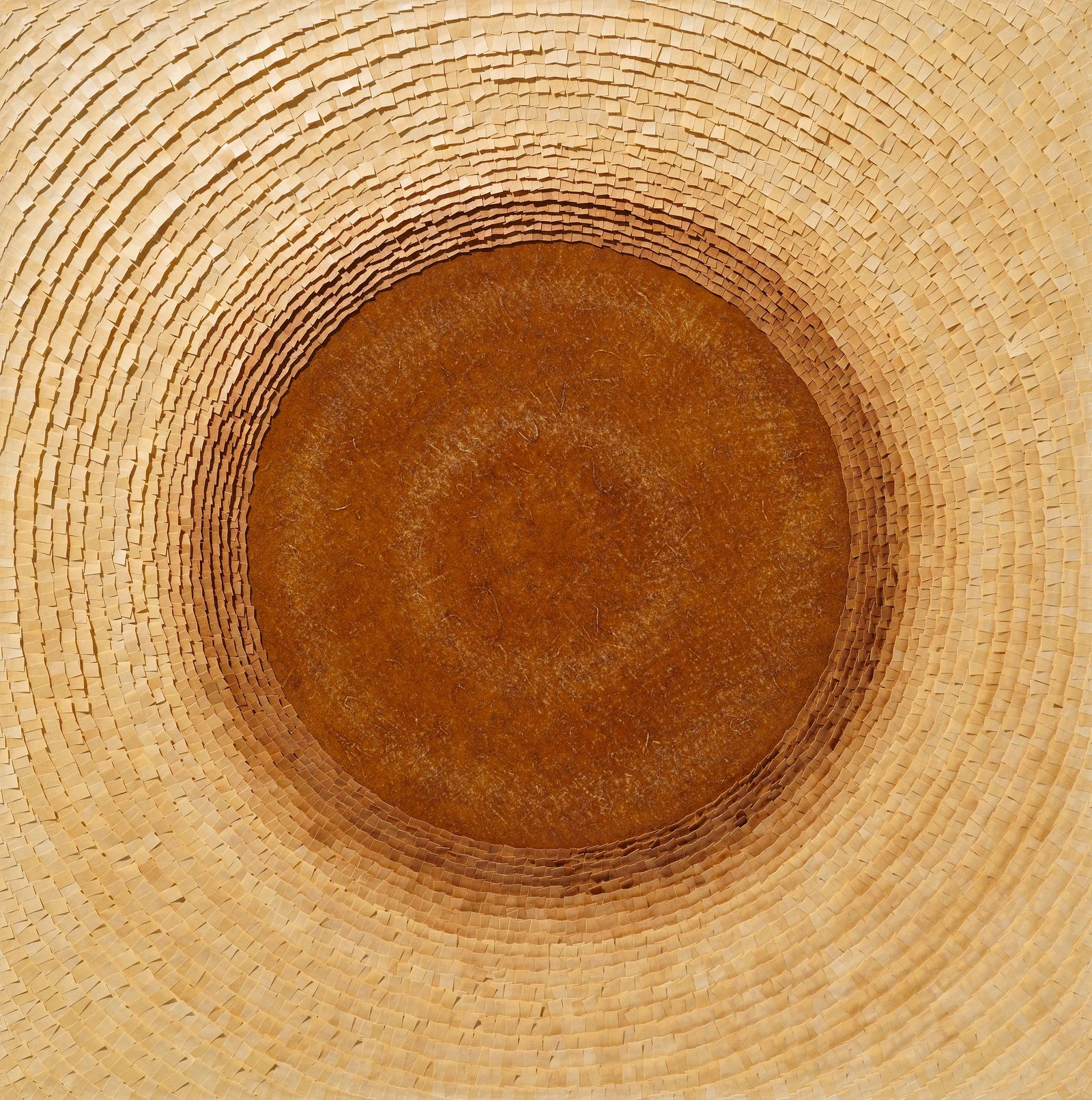
Unity (2012) is made of several hundred small squares of paper, each painted red or blue, cut, and laid down overlapping like scales until they form a circle on a plain ground. Red gathers at the rim; towards the centre the blue deepens until it is almost all there is. Harmony was made the same year, to the same size and in the same materials, and the difference between the two lies only in where the red falls. In Harmony it scatters through the whole circle. Both titles came after the works were finished, from an interest at the time in yin and yang; the red and the blue were meant as its two halves. Two years later, in Nostalgia (2014), the painted paper has gone. Squares of pale hanji lift from a canvas ninety centimetres across, each casting its own small shadow, and the rings step down, one inside the next, to a darker centre where the fibres of the paper show.
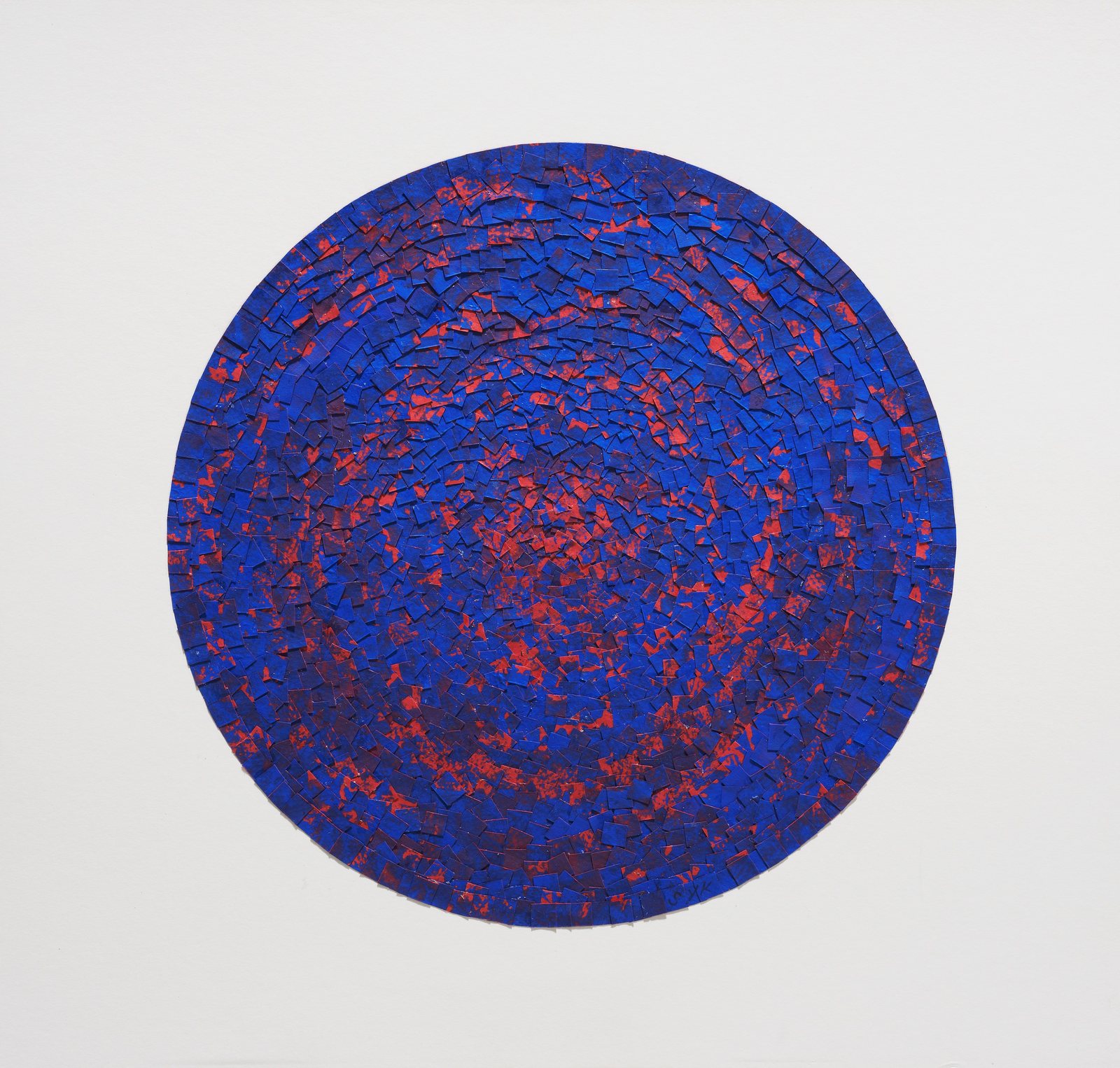
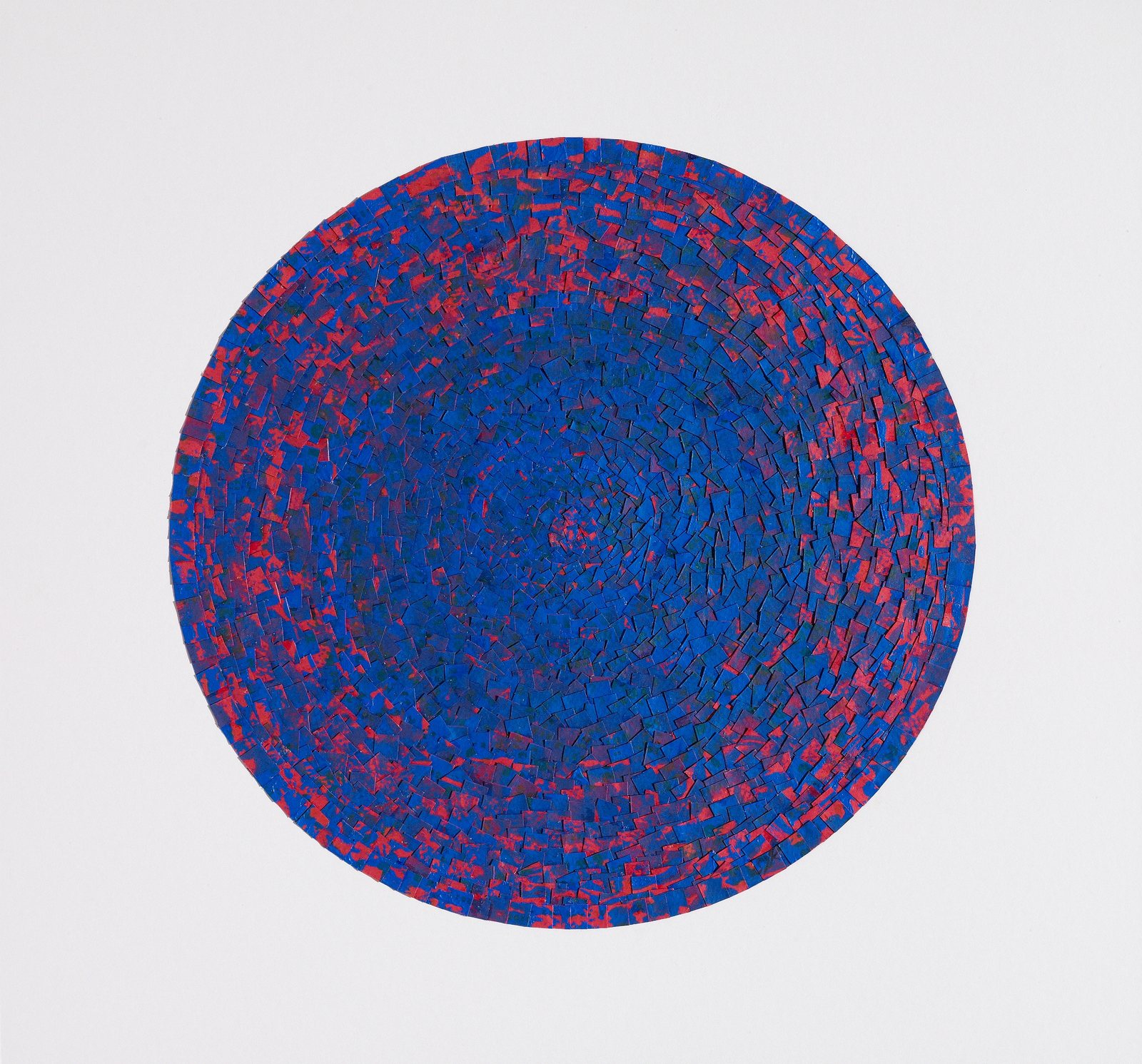
Three works, two materials, one form. The materials changed. The circle did not.
Kang trained first in textiles, at Ewha Womans University in Seoul, and then in tapestry, at West Dean and at Goldsmiths in the 1990s; she has worked in London ever since, and in 2012, when Unity was first shown at the Korean Cultural Centre UK, she was chairing the Korean Artists Association. The training is visible in the collages. Weaving builds a surface one pass at a time, each thread laid beside the last, and the image exists only once enough of them are in place. Kang's paper works are built on the same principle. A single square cannot make the image. A circle needs hundreds of them, and it needs the time it takes to set each one down.
The circle is older than either medium. Kang traces it to a childhood memory: a mother's hand circling a child's stomach, to the words eomma soni yakson, "mother's hand is medicine." She gives the circle two meanings, healing and hap, the joining of one heart to another. In 1997, in a work called Rite of Passage, she rewrote letters she had received, burned the originals and the copies, and drew circles with the ash on handmade paper. Across three decades the materials have moved from ash to tapestry to painted paper and hanji. The circle has persisted, made and remade by the movement of the hand going round.
Kang calls the repetition a ritual, a practice of healing and meditation. Sometimes the circle is set before she begins; sometimes it forms as the pieces go down. The word repetition needs some care here. It is often read as the opposite of invention, the same thing done again. In Kang's work it is the means by which anything appears at all. In 2013 she began writing words by hand on hanji, among them 마음 (maum, heart) and 사랑 (sarang, love), and cutting them into small fragments; in 2015 Invocation set a hundred such spheres side by side, like a prayer said every day for a hundred days. Unity and Harmony stand just before the words arrived; Nostalgia followed a year after they began. What looks from outside like a change of language is a change of material inside one continuous act.
Nostalgia shows most clearly what that act produces, and what time adds to it. It is made from two papers of different ages. The outer rings are cut from jangpanji, the paper once laid over the heated floors of traditional Korean rooms, which Kang bought for her work some forty years ago; the centre is a lacquered hanji of the kind sold for hanok today. The work began, she says, as a longing for those floors, now disappearing, and for a childhood spent on them. The colour deepens from the pale rim to the dark centre, and it was not painted: these are, in her account, the colours the papers have taken on over the years. The lifted edges and the steps record the accumulation of the pieces; the colour records the time. The eye reads the circle from the outside in, and arrives at the darkest point.
It would be easy to stop at the calm of these works, or to call them decorative. Neither account explains how the surface came to be. The calm is an outcome, not a starting point: the result of a discipline sustained long enough that it no longer shows the effort. What the work asks of a viewer is the same thing it asked of its maker, which is to stay with it while it accumulates.
The circle comes first. Paper, colour and word have each been a way of making it again.
Soon Yul Kang's Harmony, Unity and Nostalgia will be shown in (mean)while, KVAA's first exhibition, at St Marylebone Art Space, London, from 26 November 2026 to 25 January 2027.
— KOUM Partners, London