
In Through Gradual Ruin (2026), a ridge runs across the canvas. Close up, it resolves into sheet masks, pleated where they were laid down and stiffened by oil and wax, and at the edge of the painting one of them peels back, the way a mask lifts from the face it was made for. In The Face That Is Not (2025–26), a pink curve and three small raised squares sit on a wooden board, and the eye does what it has been trained to do with anything placed where skin might be: it looks for a face. None forms. Bae has written that she wants her paintings to "stay with what lingers just below recognition"; here, what lingers is the possibility of a face. Look longer and the rest arrives. False eyelashes, latex sponges, more masks: objects made to touch a face for a few minutes and then be thrown away.
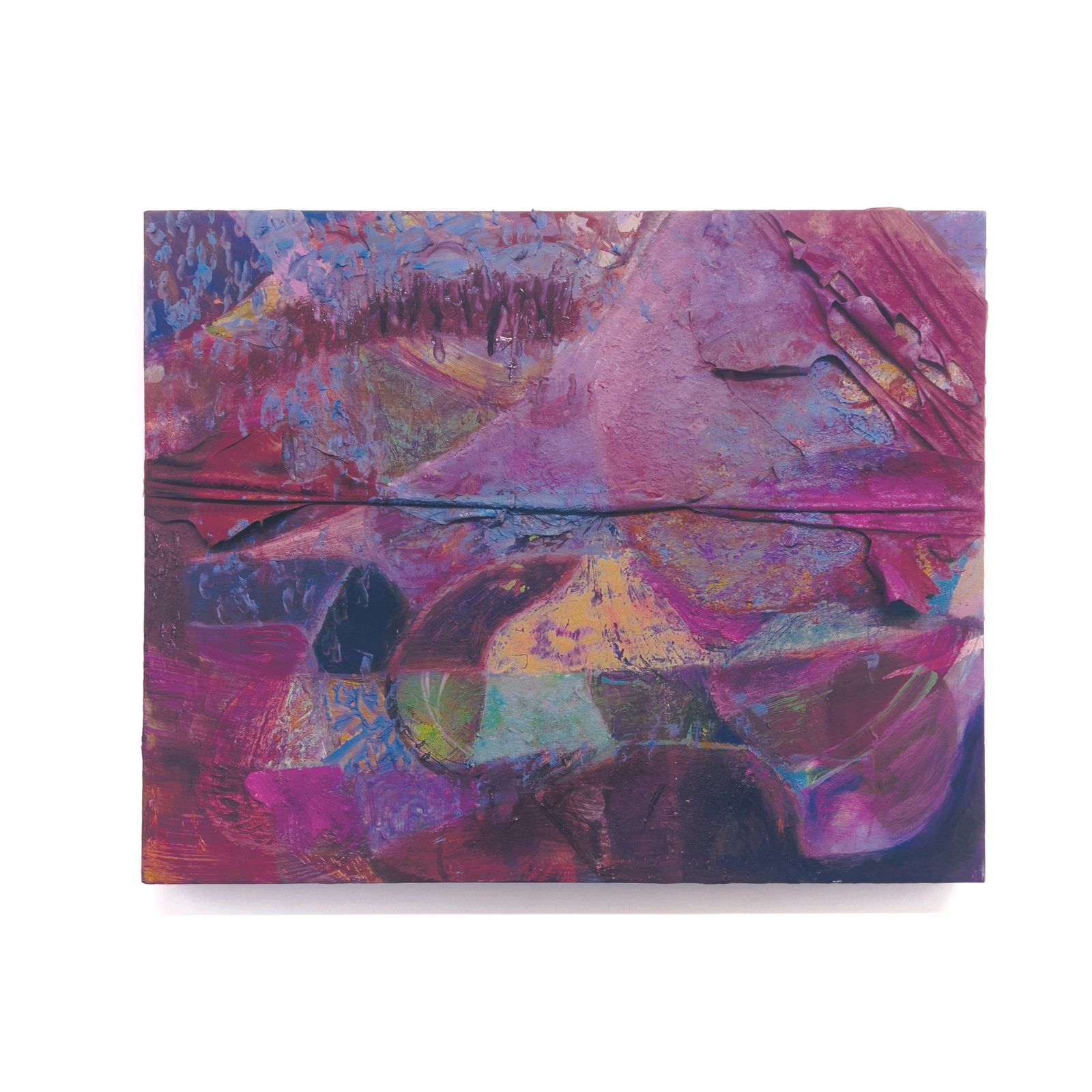
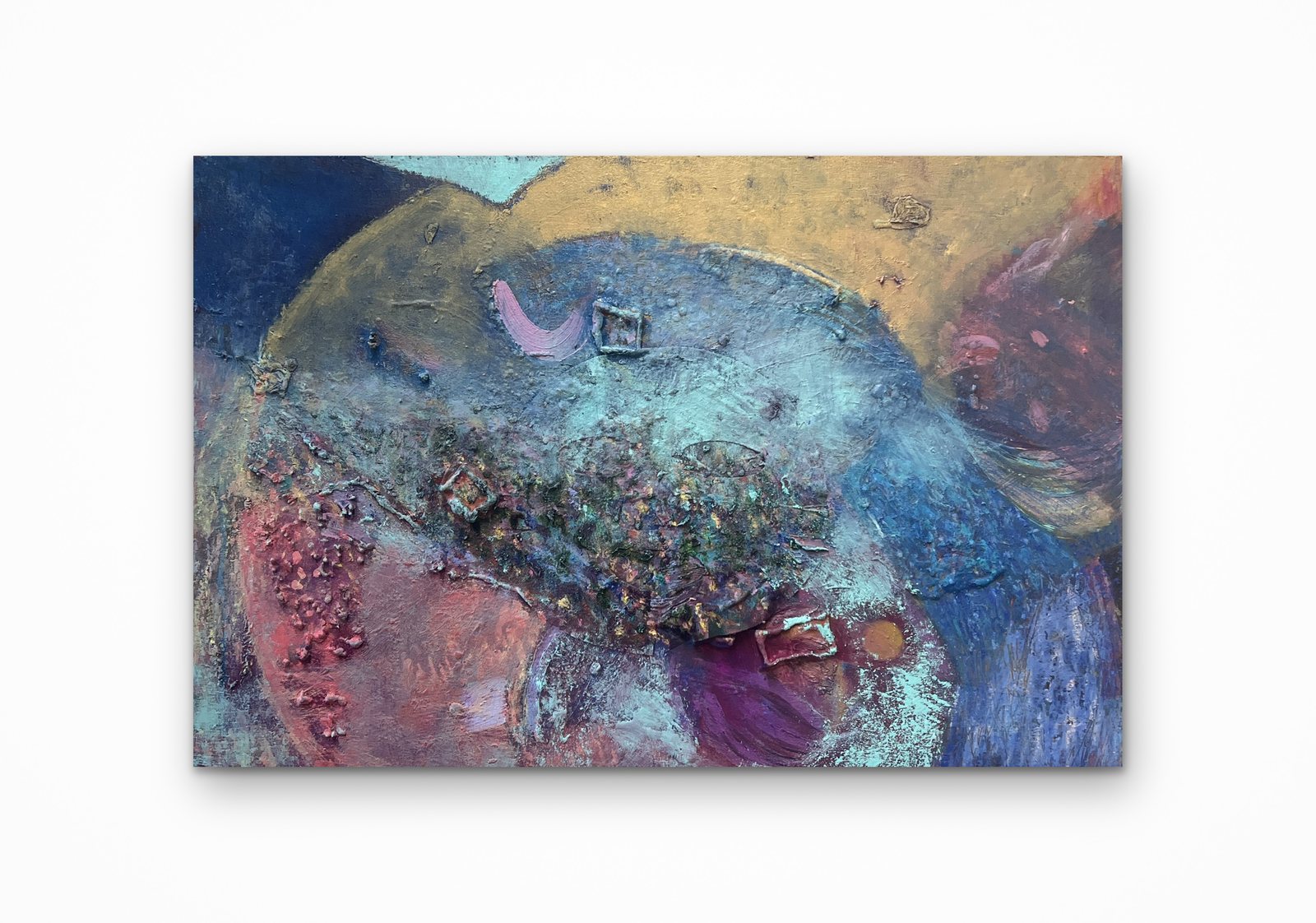
There is a decade inside these paintings that never appears on the surface. Before she studied painting at the Royal College of Art, Bae spent ten years developing cosmetics, some two hundred products by her own count. The experience shows less in the choice of material than in how it is handled. She knows which masks will hold and which will not; paper sheets endure where collagen ones fail. Her usual method is to seal them under successive layers of acrylic medium, prime the surface, wait for it to dry completely, and only then begin in oil, on a surface that will go on curing for months. Several canvases are in progress at once, and she works on one while another dries.
That patience is more than a condition of making; it becomes part of what the paintings are about. A sheet mask is designed for a short life: opened, worn once, discarded. Bae takes products made for speed and gives them to oil, a medium that will not be hurried. "In a world of speed and surface," she has written, "I make paintings that wait." The waiting is not decorative. Held in oil and wax, the mask is neither used nor thrown away; it is kept. Through Gradual Ruin names what has been undone, and it is not the material. It is the purpose: the product no longer does what it was made to do. Bae has pointed out that in Korean the word for makeup, hwajang, sounds the same as the word for cremation. The two meet in sound, not in origin. Her paintings give that coincidence a material form: something made for use is held beyond the moment of its use.
Her own phrase for what she makes is beautiful waste. She first used it, she says, at her interview for the Royal College of Art, and she uses it less as a complaint than as a release: beauty freed from the economy of function, an object that no longer has to do anything for anyone. The release is not complete. The product has lost one function, and the painting enters another economy. That reading matters, because the work is easily misread in the opposite direction. An age of images will be kind to paintings this photogenic, and that is precisely their risk: to be consumed as cosmetic paintings, K-beauty rendered in oil, the product repackaged as an image. The surface is the lure, not the subject. What Bae offers instead is a material inquiry into objects made to be intimate with the body and then dismissed, carried out by someone who has worked on the making side of that exchange.
Not every part of the practice makes this inquiry equally visible. In works such as Buoyant (2025) and Appendage of the Soul (2024), the relationship to cosmetics is less immediately apparent; the argument is clearest where the material itself makes that history visible, as in the cracked, flesh-toned crust of expired cosmetics and wax in No makeup makeup look (2024). The practice is still weighing these lines against one another.
The newest work suggests where that may lead. In the studio, translucent membranes of acrylic are being built up layer over layer, a surface she calls a second skin. If the sheet mask was the found object of this practice, the second skin may be its invented one: the point at which the paintings stop borrowing a surface designed for the face and begin to make their own.
The work is young, and it is still choosing itself. That is not a deficiency. Its questions are already its own, and the patience it asks of a viewer is the same patience its materials were never designed to receive.
Dina Jin Bae's Through Gradual Ruin and The Face That Is Not will be shown in (mean)while, KVAA's first exhibition, at St Marylebone Art Space, London, from 26 November 2026 to 25 January 2027.
— KOUM Partners, London