
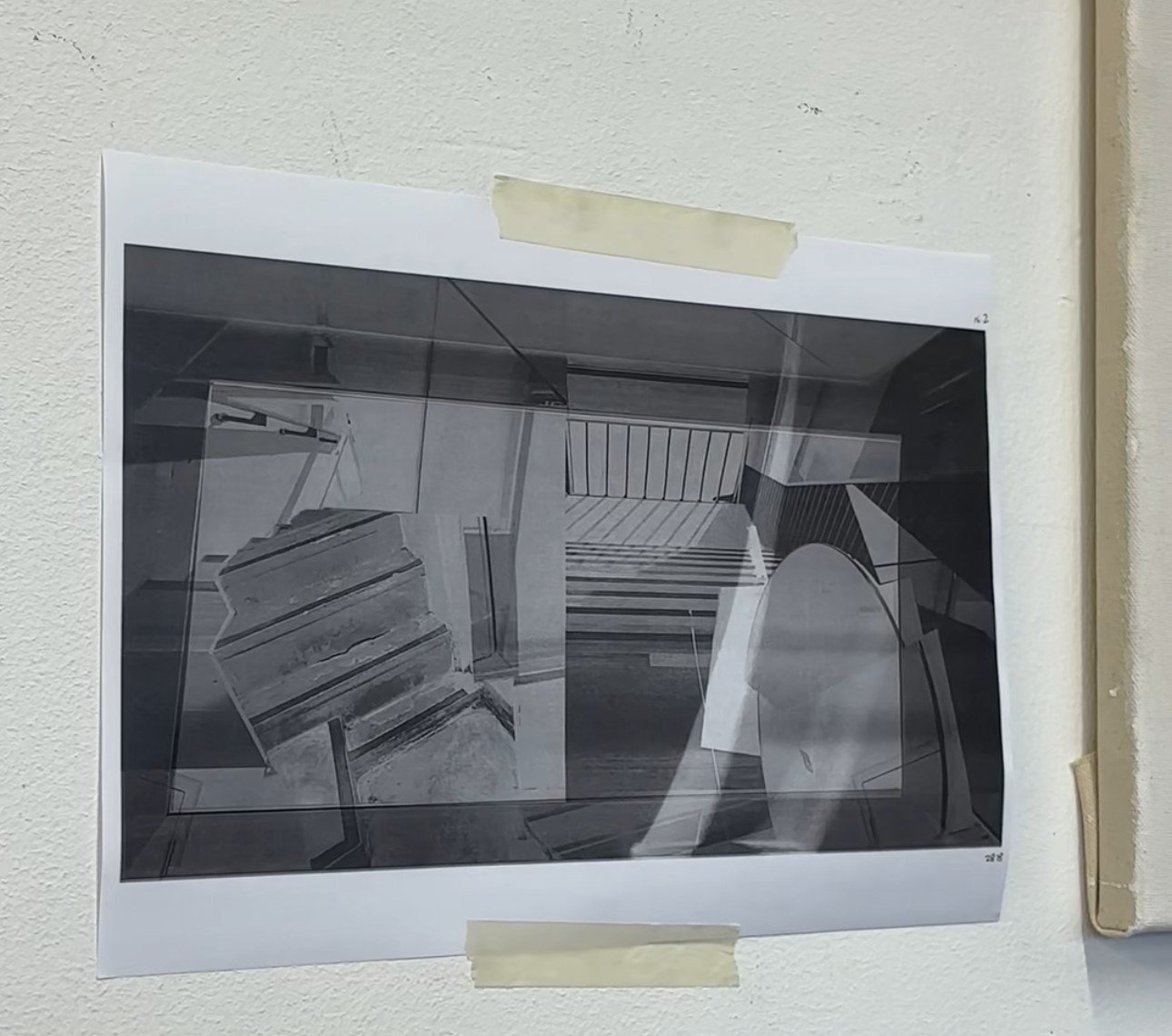
In Hongil Yoon's studio in London, a black-and-white print is taped to the wall beside a stretched canvas. It shows an interior, a staircase, a balustrade, a curved white panel, but the room has been cut into planes and laid back over itself. The stairs tilt one way and the walls another. A strip of floor slides across a strip of ceiling. Nothing in the image agrees about where the floor is. It appears to be one of the digital collages from which his paintings begin.
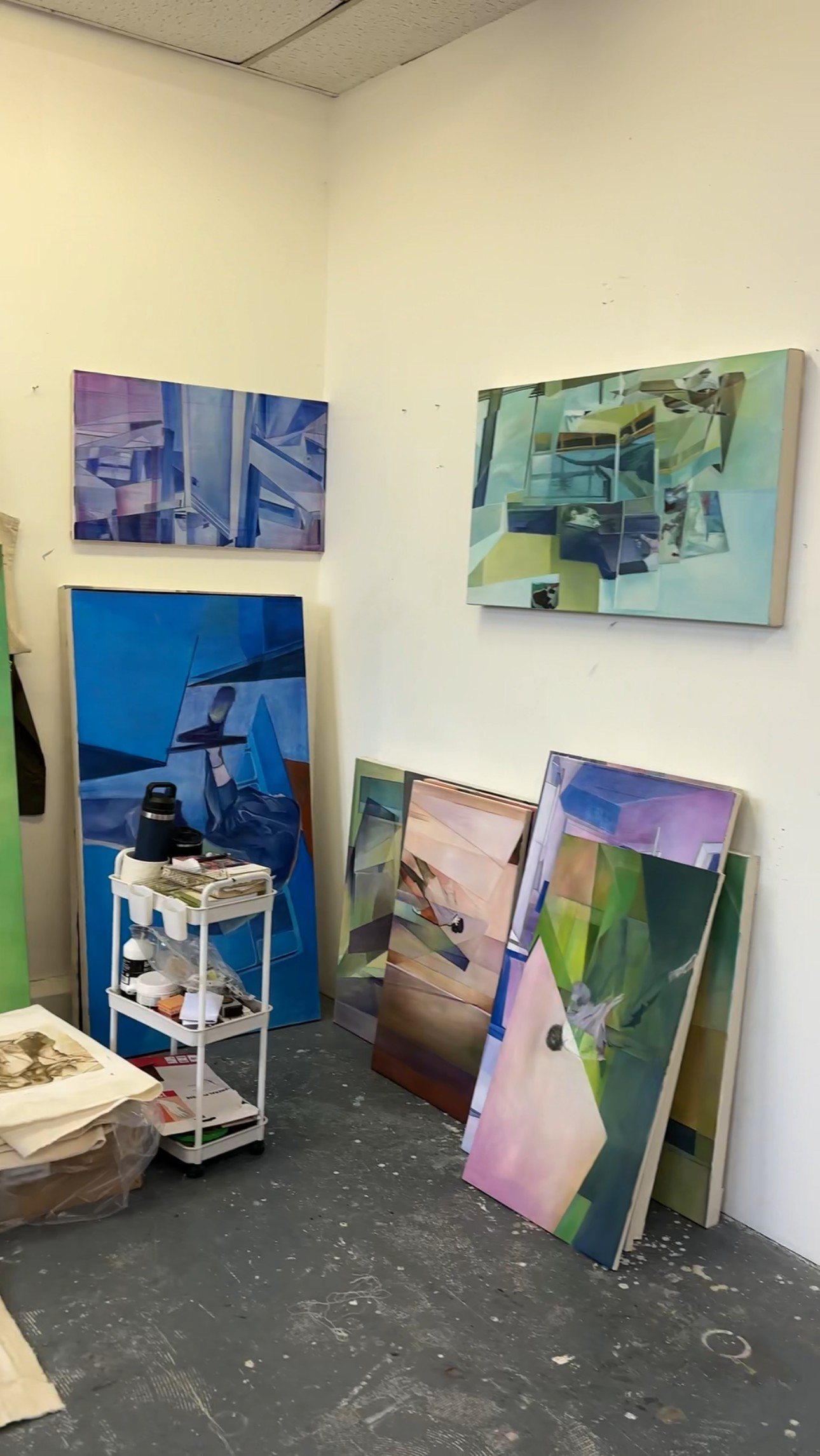
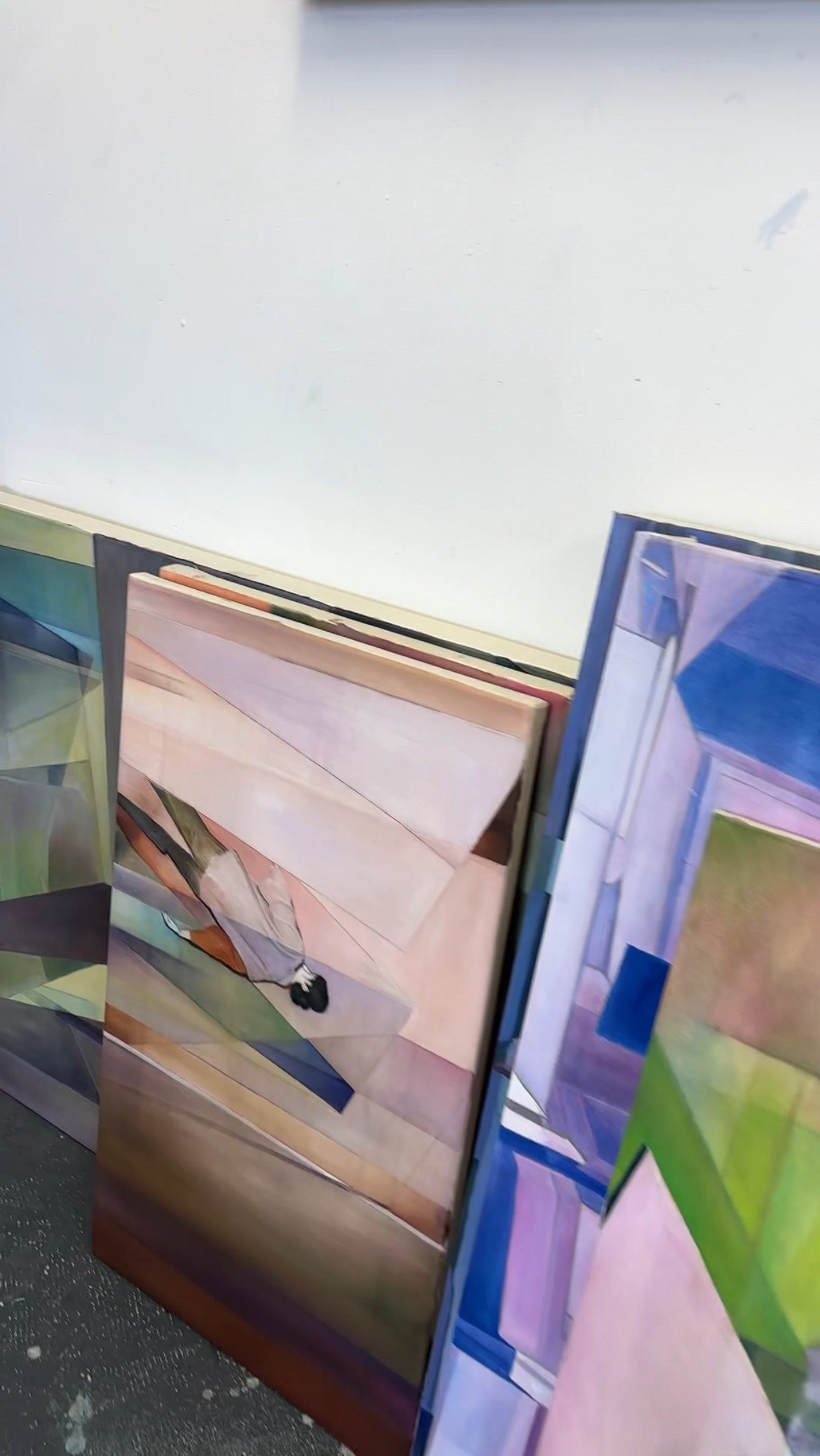
The paintings around it carry the same disagreement into colour. Blues, lilacs, pale greens and a flesh pink are divided into angled planes, hard-edged on one side and softly graded on the other, like panes of glass caught at different hours. Read quickly, they are abstractions. Read slowly, they become rooms: a window frame, a step, the edge of a table. And in some of them a figure surfaces. A pair of legs crosses a deep blue field. A small body lies head-down across a band of pink, its dark hair the only fully opaque thing in the picture.
The route between the grey collage and the coloured canvas is longer than it looks. The statement for his 2024 degree show at the Glasgow School of Art describes ideas gathered from a diary as digital collages, then intensified in poems or short stories, so that he can enter a character's situation before choosing images to paint. A memory, in other words, passes through fiction before it reaches the canvas. The same statement calls what comes out "an image of the incomplete past tense."
That route explains the paintings' strangest feature. Rather than treating architecture as the setting for a remembered person, Yoon gives the room the greater weight. The architecture is built with care, plane by plane; the figure is small, partial, often upside down, as though it has slipped through the geometry rather than stood within it. The painter's memory has passed through a character, and the character has been set down in a room that will not hold still. The body seems to arrive last, and it arrives falling.
This is why the language of memory, which can so easily turn generic, holds here. Memory in these paintings is not a faded picture of an event. It is a structure that has lost its alignment. The planes do not dissolve; they stay sharp, and it is their relation to one another that has come apart. Even the paint behaves this way: one edge of a plane is drawn hard while the other thins into a wash. A remembered room keeps its edges and loses its coordinates.
Fragmented interiors have a long lineage, from Cubism to the split screens of digital collage. In 2024 Yoon took part in Through the Shattered Mirror of Yi Sang at Norito Gallery in London, an exhibition built around the Korean modernist poet who trained as an architect and whose mirrors return a divided self. The connection is one of company rather than influence. What makes it productive is the place of writing in Yoon's own practice: a literary stage that comes before the painted image and does not appear within it.
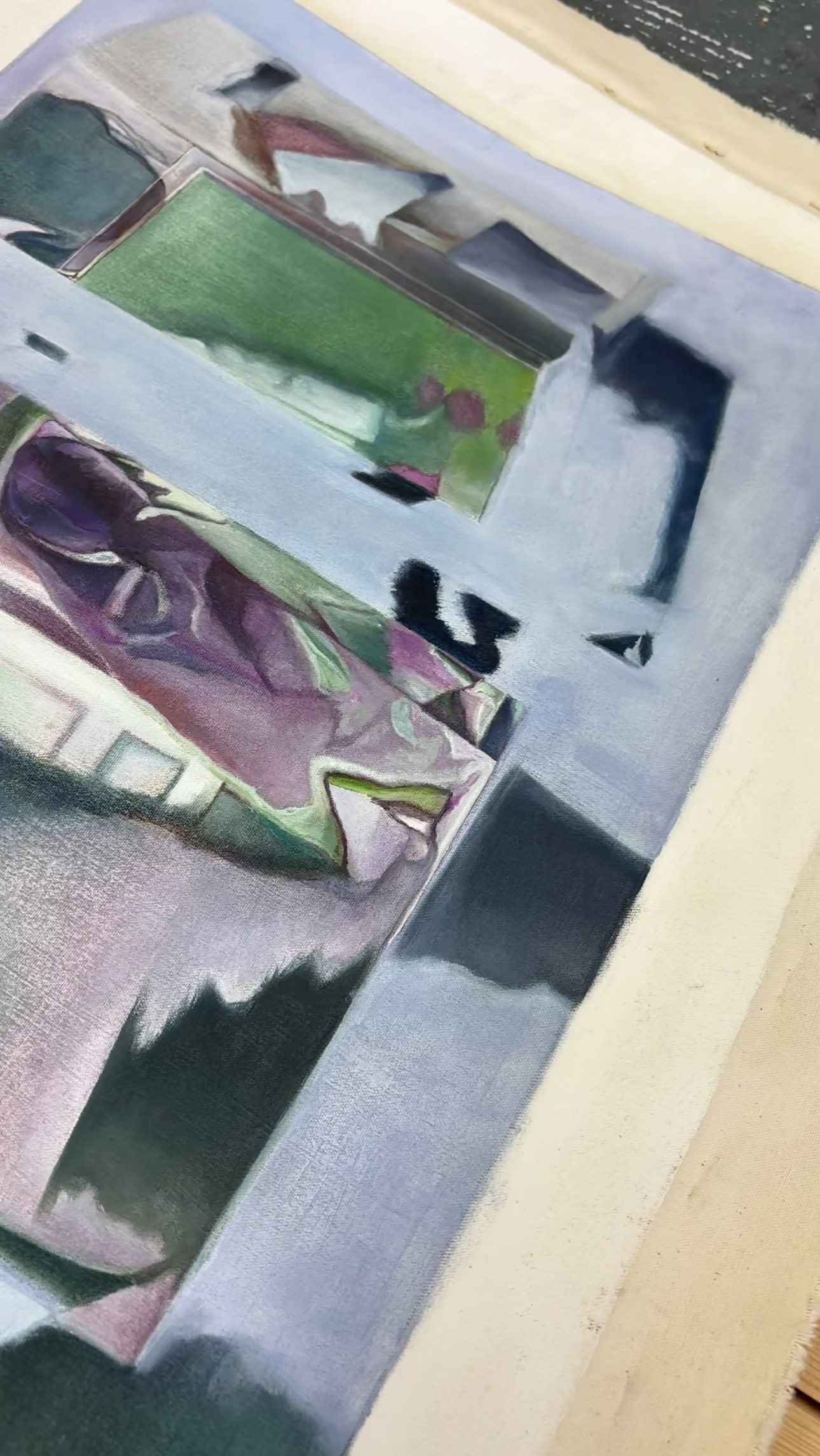
That is also where the work is still open. Yoon has begun to let other media into the work: The Heart of Bacchus (2025) pairs oil on canvas with film shot on an iPhone. But the diary, the poems and the stories stay outside the frame, and the paintings must carry them in colour and plane. Their palette of lavender, mint and rose is gentle, and the gentleness is both their appeal and their risk: a soft register can make fracture look decorative rather than disorienting. The strongest canvases are those in which colour pushes against that ease: the deep blue field the legs cross, or a canvas not yet stretched, where a green rectangle and a fold of purple sit inside a grey-blue ground like images held up to the light and not yet put away. It is worth asking whether some of the writing might one day be allowed into the room, not as explanation but as a second surface.
Yoon is not simply painting what he remembers. He is painting what remembering, and then retelling, does to a space. The figure is left to find its feet.
— KOUM Partners, London